Saturday, October 3, 2020

Biography of 'The Jewish Gandhi of Cochin - A. B. Salem' released

By Bala Menon


Happy to announce that the book ‘The Jewish Gandhi of Cochin - A Biography of Abraham Barak Salem - Indian Nationalist/Zionist’ by Bala Menon and Dr Essie Sassoon, has been released worldwide on many retail platforms (Amazon, Barnes & Noble, Infibeam, Book Depository, Indiabookstore etc.)


An official launch will be made in Toronto this month...


Here is a note on A. B. Salem

____

Abraham Barak Salem was a brilliant lawyer, labour union organizer and ardent Indian nationalist and political leader in the erstwhile Kingdom of Cochin in the early 20th century. A strong follower of Gandhian principles of peaceful protests and civil non-cooperation techniques, he was one of the three general secretaries of the Indian States’ Peoples Party, the Congress Party wing in the princely states of India. 


He was a member of the famous Lahore Session of 1939 which passed the resolution calling for complete independence or Poorna Swaraj from British rule.


Salem was a founding member of the Cochin Legislative Council way back in 1925, which set the stage for democracy later. If Kerala is known as the most literate state in India today, it was because of Salem who first introduced a bill for free and compulsory education for all in the early 1940s. He also pioneered great social reform bills like Pension for Widows and Food Rations For The Poor in the Cochin Kingdom. A powerful orator, the largest open ground in Cochin was once known as Salem Maidan. He was also part of the Gandhian temperance and lower caste temple entry movements in Kerala.


He was friends with top political leaders of the time like C. Rajagoplachary, Periyar Ramaswamy Naicker, Sardar K. M. Panikkar and Jawaharlal Nehru. In Teen Murti House there is a large photograph of Salem with Nehru - the only one where Nehru is shown with a single individual.


Salem was also the man behind the mass emigration of Cochin Jews to Israel, because of his friendship with Israeli leaders like Yitzhak Ben-Zvi, Moshe Sharett, David Ben Gurion and others - although he and his family chose to stay back in his beloved state of Kerala. Salem, who died in 1967, is buried in Mattanchery in Cochin. There is a road named after him in the area.

Sunday, December 9, 2018

Cochin Jews gather for 450th anniversary of Mattancherry Synagogue

By Entrita Veliparambil

(Reproduced from her post in Facebook #ILOVEKOCHI - Picture by Vikas Fort)

കഴിഞ്ഞ ഒരു നൂറ്റാണ്ടിനിടെ കൊച്ചിയിൽ നിന്ന് ഇസ്രായേലിലേക്ക് കുടിയേറിയവരുടെ പിന്തുടർച്ചക്കാർ, കൊച്ചിയെ ഒരിക്കൽ കൂടി കാണാനും പൂർവ്വികർ പരിചയപ്പെടുത്തിയ കൊച്ചിയെ അടുത്തറിയാനും, തങ്ങളുടെ പൂർവ്വികർക്ക് ജന്മം നൽകിയ ചരിത്ര മണ്ണിലെത്തി കേട്ടതൊക്കെ നേരിൽ കാണാനും 175 ഓളം ജൂതരാണ് കഴിഞ്ഞ ഒരാഴ്ചക്കാലമായി കൊച്ചിയിൽ തങ്ങിയത്...

കൊച്ചിയിൽ ഒത്തു കൂടണമെന്ന അവരുടെ ഈ ചിരകാല മോഹത്തിന് മജ്ജയും മാംസവും നൽകിയത് മട്ടാന്ചേരി സിനഗോഗ് സ്ഥാപിതമായതിന്റെ 450-ാം വാർഷികവേളയും...

അങ്ങനെ കഴിഞ്ഞ മൂന്നു ദിവസങ്ങളിൽ അവർ മട്ടാന്ചേരി സിനഗോഗിലും മറ്റുമായി ഒത്തുകൂടി..ചരിത്ര സൗന്ദരൃം പേറുന്ന സിനഗോഗ് അങ്ങനെ 1968 നു ശേഷം ഒരിക്കൽ കൂടി ജൂത സംഗമത്തിന് ചരിത്ര സാക്ഷിയായി...

ഈ ചരിത്ര വേളയെ ധനൃമാക്കാൻ ഇസ്റായേൽ , അമേരിക്ക, കാനഡ, ഇംഗ്ളണ്ട്,ആസ്ത്രേലിയ എന്നിവിടങ്ങളിൽ നിന്നുമാണ് ജൂതർ കൊച്ചിയിലേക്കെത്തിയത്..

ഇസ്രായേലിൽ ജൂതരുടെ വിശേഷ ആഘോഷമായ പ്രകാശത്തിന്റെ ഉത്സവം എന്നറിയപ്പെടുന്ന#ഹനൂക്കാഹ് യോടനുബന്ധിച്ച്, ഈ ദിവസങ്ങളിൽ ലഭിക്കുന്ന അവധി മുതലാക്കിയാണ് പ്രായം ചെന്നവരും കുട്ടികളുമടക്കം കുടുംബ സമേതം തന്നെ എല്ലാവരും കൊച്ചിയിലേക്കെത്തിയത്.. 

ഇവരിൽ ആദൃമായി കൊച്ചിയിലെത്തുന്നവരും വർഷം തോറും കൊച്ചി സന്ദർശനം പതിവാക്കിയവരും ഒക്കെയുണ്ട്..കൊച്ചിയിൽ ജീവിച്ചിരുന്ന ജൂതരിൽ 95%വും ഇസ്രായേലിലേക്കാണ് കുടിയേറിയിരുന്നത്...

അതുകൊണ്ട് തന്നെ വെളുത്ത ജൂതർ എന്നു കൂടി വിളിപ്പേരുളള ഈ #കൊച്ചിജൂതർ അവിടെ ഒത്തു ചേരുന്നതും പതിവാണ്...പക്ഷെ കൊച്ചിയിൽ നടത്തിയ ഈ ഒത്തുച്ചേരൽ അവരുടെ പ്രതീക്ഷയ്ക്കും അപ്പുറം നിറമുളളതായി മാറി..

സ്വവംശത്തെ നില നിറുത്താൻ അതീവ ജാഗ്രത പുലർത്തുന്ന സമൂഹമാണ് ജൂതരുടേത്...

പക്ഷെ അര സഹസ്രാബ്ദത്തോടടുത്ത് തലമുറകളായി കൊച്ചിയോടു ഇവർ പുലർത്തിയ സൗഹൃദം ഒട്ടും ചോർന്നു പോകാതെ സൂക്ഷിക്കാൻ ഈ വെളുത്ത ജൂതരുടെ പുതു തലമുറക്കാർ അതീവ ജാഗ്രത കാട്ടുന്നു എന്നതാണ് അവരുടെ ഈ ഏറ്റവും പുതിയ സന്ദർശനം വെളിവാക്കുന്നത്...

കൊച്ചിയെ മറക്കാനാവില്ല എന്നും കൊച്ചി തങ്ങളുടെ പൂർവ്വികരെ പരിപാലിച്ചതിനു നന്ദി ഉണ്ടെന്നും അവർ പറഞ്ഞ വേളയിൽ കൊച്ചിയുടെ സഹിഷ്ണുതയാണ് സ്മരിക്കപ്പെട്ടത്.... (See also Conference about Cochin Jews in Kerala)

44 വർഷങ്ങൾക്ക് മുമ്പ് കൊച്ചിയിൽ നിന്ന് ഇസ്രായേലിലേക്ക് കുടിയേറിയ, #ശബ്ദായ്സാമുവൽകോഢറിന്റെ മകൻ 80 തികഞ്ഞ #സാനികോഢർ വീൽ ചെയറിലാണ് കൊച്ചിയിലെത്തിയത്...അദേ്ദഹം സംസാരിച്ചതു മലയാളത്തിലും..ഇസ്രായേലിൽ താമസിക്കുന്ന തങ്ങളുടെ മക്കളും കൊച്ചു മക്കളും വീടുകളിൽ മലയാളമാണ് സംസാരിക്കുന്നതെന്നും മലയാളത്തെ കൈ വിടാനാവില്ല എന്നും സാനി പറഞ്ഞത് ഓരോ മലയാളിയുടെയും മനസിൽ പതിയേണ്ടതാണ്...

ഉച്ഛാരണശുദ്ധിയോട് കൂടി തന്നെയാണ് അവർ മലയാളം കൈകാരൃം ചെയ്യുന്നത് എന്നതും ശ്രദ്ധേയമായി..
കോമൺ വെൽത്ത് രാജൃങ്ങളിലേതിൽ വച്ച് ഏറ്റവും പഴക്കം ചെന്നതും പ്രവർത്തിക്കുന്നതുമായ 1567ൽ പണി കഴിപ്പിച്ച മട്ടാന്ചേരിയിലെ #പരദേശിസിനഗോഗ് ഇതാദൃമായല്ല ജൂതരെ ഒരുമിപ്പിക്കുന്ന ശക്തി കേന്‌ദ്രമാവുന്നത്...

1968ൽ സിനഗോഗ് സ്ഥാപിതമായതിന്റെ 400-ാം വർഷം സമുചിതമായി ആചരിക്കാനും ജൂതർ ഒത്തുകൂടിയിരുന്നു..അതും കൊച്ചിയുടെ സ്വന്തം കോഢറച്ചയും കൊച്ചി ജൂതർ എന്ന വടവൃക്ഷത്തിന്റെ തായ് വേരുമായിരുന്ന #ശബ്ദായ്സാമുവൽകോഢറിന്റെ ആദ്ധൃക്ഷതയിൽ... 

അന്നത്തെ ഇന്ഡൃൻ പ്രധാനമന്ത്രി #ഇന്ദിരഗാന്ധി ആയിരുന്നു ആഘോഷം ഉദ്ഘാടനം ചെയ്തത്...എന്നാലിന്ന് കോഢറച്ചയുടെ അസാന്നിദ്ധൃം വരുത്തിയ വിടവ് നികത്താൻ 450-ാം വാർഷിക ആഘോഷങ്ങളുടെ നേതൃത്വം നൽകിയ ജൂത കൂട്ടായ്മയ്ക്കായില്ല എന്നത് വാസ്തവം..ഈ പുതിയ ഒത്തുചേരൽ ഉദ്ഘാടനം ചെയ്തത് അവരുടെ ഇസ്രായേൽ അംബാസഡർ #റെയ്നിഡെവിൻസ്റ്റർ ആണ്...

ഒരാഴ്ച നീണ്ട കൊച്ചി സന്ദർശനത്തിന്റെ അവസാന മൂന്നു ദിവസങ്ങൾ അവർ സിനഗോഗിൽ,പ്രാർത്ഥനയ്ക്കും മറ്റുമായി ചിലവിട്ടു...

1972ൽ വെളുത്ത ജൂതരുടെ എണ്ണം അന്ചായി ചുരുങ്ങിയപ്പോൾ ജൂതരുടെ വിശുദ്ധ ഗ്രന്ഥമായ #തോറാഹ്അവർ ഇസ്രായേലിലേക്ക് കൊണ്ടു പോയിരുന്നു...

എന്നാൽ 45 വർഷങ്ങൾക്കിപ്പുറം അവർ #തോറാഹ്‌ മായാണ് കൊച്ചിയിലേക്കെത്തിയത്...

പ്രാർത്ഥന വേളയുടെ തുടക്കത്തിൽ #തോറാഹ് മായി അവർ സിനഗോഗ് വലംവച്ചു...

തുടർന്ന് ദേവാലയത്തിൽ പ്രവേശിച്ച് ഒന്നര മണിക്കൂർ നീണ്ട പ്രാർത്ഥന നടത്തി..വിശിഷൃ വേളയിൽ ഉപയോഗിക്കുന്ന ഏഴ് തിരി നാളങ്ങളോട് കൂടിയ #ഹനൂക്കാഹ് വിളക്ക് കത്തിച്ചു…

സിനഗോഗിന്റെ തിരുമുറ്റത്ത് തയ്യാറാക്കിയ 82 തിരി നാളങ്ങളോട് കൂടിയ ആൽവിളക്കിൽ കാനഡയിൽ നിന്നെത്തിയ ലോറിയനാൻ തിരി തെളിച്ചു...

ജൂതർ കൊച്ചിയിലായിരുന്ന കാലത്ത് അവരുടെ 82 ഓളം കുടുംബങ്ങളെ പ്രതിനിധീകരിച്ച് ആണ് 82 തിരിനാളങ്ങൾ ആൽ വിളക്കിനുളളത്..പ്രാർത്ഥനയ്ക്കു ശേഷം അവർ സൗഹൃദം പന്കു വച്ചു....

ഒരുമിച്ച് കൃാമറക്കണ്ണുകൾക്ക് മുന്നിൽ നിരന്നു...

സ്ത്രീകളിൽ സാരി വേഷധാരികളും ഉണ്ടായിരുന്നു..

പിന്നീട് ജൃൂ സ്ട്രീറ്റിലെ അവരുടെ പുരാതന ഭവനങ്ങൾ സന്ദർശിച്ചു..കൊച്ചിയിലെ അവശേഷിക്കുന്ന സാറാഹ് കോഹനടക്കമുളള 5 വെളുത്ത ജൂതരെ അവർ സന്ദർശിച്ചു...ഈ ഭവനങ്ങളിൽ ഇവർക്കായി പരമ്പരാഗത ഭക്ഷണങ്ങളും ഒരുക്കിയിരുന്നു.

ഇസ്രായേൽ രാജൃം രൂപപ്പെട്ടതോടെ അങ്ങോട്ട് പലായനം ചെയ്ത വെളുത്ത ജൂതർക്ക് ജൂത ജീവിത ശൈലി പിന്തുടരാനും സ്വവംശത്തെ പരിപോഷിപ്പിക്കാനും അതിയായ താത്പരൃം ഉണ്ടായിരുന്നു...

അതു കൊണ്ട് തന്നെയാണവർ എന്നന്നേയ്ക്കുമായി കൊച്ചി വിട്ടതും...ഒരർത്ഥത്തിൽ ജീവിത പന്കാളിയെ ജൂതരിൽ നിന്ന് തന്നെ ലഭിക്കാൻ..പക്ഷെ,തങ്ങളുടെ സമൂഹത്തെ, തങ്ങളുടെ സംസ്കാരത്തെ കൊച്ചിയിൽ പരിചയപ്പെടുത്താൻ, ജൂത ചരിത്രത്തിന് കൊച്ചിയുമായുളള ബന്ധം ദൃഢപ്പെടുത്താൻ സിനഗോഗിനോട് ചേർന്ന് ഒരു മൃൂസിയം ആരംഭിക്കാൻ അവർ പദ്ധതി തയ്യാറാക്കി വരുകയാണ്. ഒരു പക്ഷെ സിനഗോഗിന്റെ 500 -ാം വാർഷിക ആഘോഷത്തിനായി അവർ ഒത്തു കൂടുമ്പോൾ അവരുടെ ഗതക്കാല ചരിത്രം പറയാൻ ഒരു മൃൂസിയവുമുണ്ടാവും മട്ടാന്ചേരിയിൽ...

മാറി മാറി കൊച്ചി ഭരിച്ച രാജാക്കന്മാരുടെ സഹിഷ്ണുത - #രാജാരാമവർമ്മഔദാരൃപൂർവ്വം സിനഗോഗ് പണിയാൻ നൽകിയ അനുവാദവും അതിനായി സൗജനൃമായി നൽകിയ ഭൂമിയും കൊച്ചിയുടെ ചരിത്രത്തിൽ അങ്ങനെ ഏടുകൾ കൂട്ടിചേർത്തു കൊണ്ടിരിക്കുകയാണ്...

പക്ഷെ ആ മനസ്കതയ്ക്ക് ചേർന്ന സഹകരണം കാണിക്കാൻ നമ്മുടെ ഇന്നത്തെ അധികാരികൾക്ക് ആവുന്നില്ല എന്നതാണ് ഖേദകരം...

ജൂതരുടെ ഈ അവിസ്മരണ ഒത്തുച്ചേരലിന് ശോഭ കൂട്ടാനാകുന്നത് ചെയ്യേണ്ടതായിരുന്നു കൊച്ചി നഗരസഭയും കേരള സർക്കാരും…


( #ചിത്രം നൽകിയ വികാസ് ഫോർട്ട് സുഹൃത്തും കൊച്ചിയിലെ പ്രമുഖ ഫ്രീലാൻസ് ഫോട്ടോഗ്രാഫറുമാണ് )

'Jews In India, Jews of India' conference in Kerala - Jan 9-12, 2019

Shrihariprasad, Managing Trustee of the Sri Vishnu Mohan Foundation, has announced a conference with special sessions on the Jews in Kerala, the Bene Israelis of Maharshtra and the Baghdadi Jews of Kolkata as well as the contributions of Jews to South Asian society.  

The conference will be inaugurated in Ernakulam at the centuries-old Kaduvambagam Synagogue inside the Mather Bazaar in Ernakulam, which the SVMF is helping to restore. 

(A Sefer Torah from Israel arrived at the partially restored grand synagogue, with several Jews from Israel in attendance to pray and witness the placing of the Torah in its rightful place in the Ark).
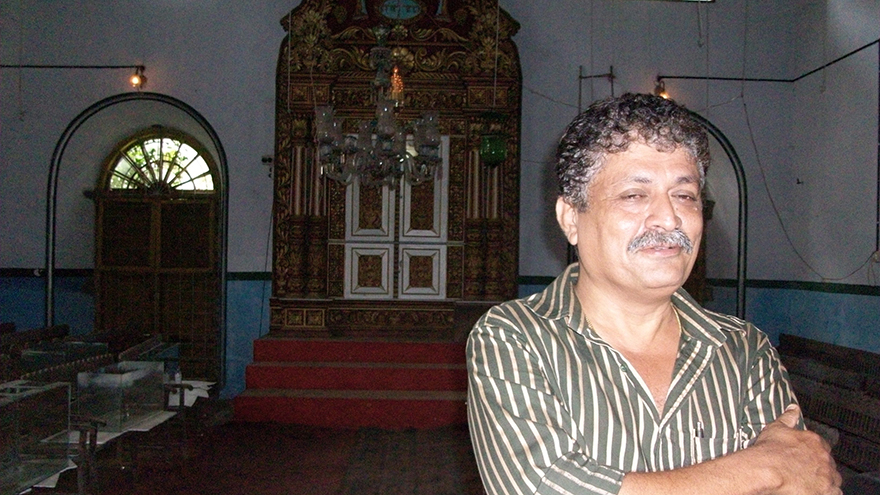
'Babu' Elias Josephai, caretaker of the Kadavumbhagam Synagogue. Pic: Bala Menon
The conference will conclude with a Muziris Project boat tour including visits to synagogues in Parur and Chennamangalam and well as the Paliam Palace. 

The palace overlooks a synagogue, mosque, church, and Hindu temple. A workshop  will be devoted to creating a network of scholars, curators, archivists, librarians, collectors, and Indian Jewish groups devoted to the preservation of Indian Jewish material culture.

All are welcome. For further information, contact the SVMF at vishnufoundation@gmail.com Scholars are invited to send lecture and workshop proposals of 250 words or less to both Shrihariprasad [vishnufoundation@gmail.com] and Kenneth X. Robbins [rajanawab@kjrobbins.com].

For more info, you can also contact: nishaarjun9@gmail.com

SVMF is a non-profit research foundation in its formative period. The foundation “strives to harness interdisciplinary approaches and cross cultural contexts to rediscover, formulate and create pathways to transforming lives through original research, meaningful platforms, discussion forums, seminars and partnerships with organisations and individuals who are keen to bring forth knowledge and connection with the timeless, purifying, and transformational  views of the teachers of mankind.” 

The SVMF is known for its annual Seminar on Peace and Reconciliation. 
nahi jnanena sadrsam pavitram iha vidyate
There is nothing so purifying as knowledge


Saturday, December 8, 2018

Links to Media reports on Paradesi Synagogue celebrations

Here are links to media reports about the 450th anniversary of the Paradesi Synagogue in Mattancherry. Some 175 Jews from across the world - and many who settled in Israel decades ago - are visiting Kochi to celebrate Hanukkah and the synagogue celebrations.

The Times of India

https://timesofindia.indiatimes.com/city/kochi/synagogue-to-mark-450th-anniversary/articleshow/66959047.cms

The Times of India

https://timesofindia.indiatimes.com/city/kochi/jews-reminisce-about-childhood/articleshow/66993899.cms

The Times of India

https://timesofindia.indiatimes.com/city/kochi/200-jews-arrive-in-kochi-to-mark-450th-anniversary-of-paradesi-synagogue/articleshow/66979476.cms

The New Indian Express

http://www.newindianexpress.com/lifestyle/travel/2018/dec/07/they-descended-on-the-city-to-relive-the-halcyon-days-1908292.html


The Deccan Chronicle

https://www.deccanchronicle.com/nation/current-affairs/081218/kochi-home-for-jews-but-separate-legacies.html

The Hindu

https://www.thehindu.com/life-and-style/cochini-jews-assemble-to-celebrate-the-450th-anniversary-of-the-synagogue-in-jew-town-kochi/article25732723.ece

Metro Vartha

http://www.metrovaartha.com/news/16854/paradesi-synagogue-kochi-450th-anniversary-special-feature

NewsJizz

https://newsjizz.com/94624-200-jews-arrive-in-kochi-to-celebrate-the-450th-anniversary-of-the-paradesi-synagogue.html

Manorama Online

https://travel.manoramaonline.com/travel/travel-news/2018/11/21/mattancherry-synagogue-to-celebrate-its-450th-anniversary.html

Mathrubhumi - English

https://english.mathrubhumi.com/news/good-news/jews-return-to-mattancherry-to-celebrate-450th-anniversary-of-synagogue-1.3376949

(In the Mathrubhumi report, the name of David Hallegua is given as David Halligan - obviously an ignorant reporter! Also, he has mixed up the 'Torah'celebrations of the Kadavumbhagam Synagogue in Ernakulam with that of the Mattanchery one!)

A short film on the dwindling Jews of Cochin

Here is a seven and a half minute short film on the Jews of Cochin released by Religion and Ethics Newsweekly - Hosted by veteran journalist Bob Abernethy and produced by Thirteen/WNET New York.

 The video features interviews with my friends Elias (Babu) Josephai, caretaker of the Kadavumbhagam Synagogue in Ernakulam, and Prof. C. Karmachandran, who heads the Mala Heriage Committe now fighting for preserving Jewish monuments in the beautiful settlement of Mala.

The video and transcript can be seen in full at: http://www.pbs.org/wnet/religionandethics/2016/05/13/jews-cochin-india/30450/

Tuesday, October 6, 2015

Thomas Master and the Jewish monuments in Mala


Guest post by Prof. C. Karmachandran
Former Associate Professor (History)
C. Achuta Menon Government College, Kuttanellur

The one year long birth centenary celebrations of late K A Thomas master (b 1916- d 2011) who made a deep imprint in the history of Mala, more exactly of central Kerala as a freedom fighter, political leader and a social and cultural activist commenced on 2nd of October, 2015.

He was the President of Poyya, the neighbouring Panchayat for 15 years and the Chairman of Mala Development Block for ten years. He contested against the former Chief minister K Karunakaran and was defeated by a slender margin of mere 364 votes in 1967.


During 80's he gradually withdrew from political activities and started concentrating his attention on social and cultural activities when he came across the pathetic condition of the millennium old Jewish Monuments at the hands of Mala Panchayat. Despite the fact that it was bound by an agreement of 1955 to preserve the Jewish monuments in Mala the Panchayat chose to neglect the same.

Towards the end of 80's it was he who organised a popular movement in Mala for the first time demanding the protection of the Jewish monuments. He was the founder chairman of the Jewish Monuments Protection Committee that spearheaded the activities to save the Jewish monuments in Mala. Under his able leadership the committee organised public meetings and various other forms of agitations such as satyagraha, demonstrations, and legal activism.

He gave representations to the Archaeological authorities of the central and state governments for the purpose. He associated himself with the Jewish organisation of Cochin who in 1994 approached the High Court of Kerala for restraining Mala Panchayat from violating the agreement of 1955.

The Panchayat was constrained to give an affidavit in the court that it would honour the agreement and preserve the Jewish monuments. Unfortunately when he was forced to give up his activities due to failing health and old age the Panchayat resumed its anti heritage activities in the Jewish cemetery.

It is significant to note that despite being an atheist and a rationalist he championed the cause of preserving a synagogue and a cemetery, both related to Jewish religious belief. To him the Jewish monuments in Mala were the symbols of the proud and lofty tradition of the religious harmony and cultural inclusiveness that existed in ancient Mala and Kerala.

Let us pay a glowing a tribute to his unforgettable memories on this occasion.

Thursday, January 1, 2015

Mala Activists Campaigning To Preserve Jewish Monuments

By Bala Menon

The Mala Heritage Committee will observe the 60th anniversary of the historic 1955 Mala Jewish Agreement  on Sunday 4th January 2015 in Mala. See earlier report here: (Mala, once a flourishing Jewish settlement, is located 32 km north of Cochin). The event is being organized under  the leadership of activists Prof.C. Karmachandran and K Venu.
The seminar announcement
The Mala agreement is considered one of its kind in the world, where a Jewish congregation bequeathed, in good faith, its synagogue and cemetery for safekeeping to the town council, when emigrating to the Holy Land.

It was on January 4, 1955 that the elders of the Mala congregation and the local town council signed the document in the Mala Sub-Registrar's Office. A member of the Ernakulam congregation named Avraham, a member of the famed Pallivathukkal family named Eliyacha, and one Eliah Bai from Chennamangalam were also signatories to the agreement along with Mala panchayat (local body) president A. D. Joseph.

The document details (in its A Schdule) the 23 Cents (1/4th acre approx.) of property on which the Mala Synagogue is located and (in its B Schedule), 4 acres of land which was the Jewish cemetery in the heart of the town.

The agreement stipulated that the panchayat would bear the expenses for maintenance and repair of the Synagogue building and the cemetery; that proper signboards would be erected to show that these are Jewish monuments and that these properties would never be encroached upon on used for other purposes. The Synagogue would not be used as a place of worship by any other community and that the tombstones in the cemetery would be left undisturbed along with the surrounding land; proper walls would surround the cemetery along with a gate and the land would be available for the burial of any Jew for all time.

Unfortunately, the agreement was violated  even before the ink dried on the agreement. No maintenance or repair work was ever done; the synagogue building was for some time used as a primary school and later as a community hall by all and sundry. The western side of the synagogue was sealed off to facilitate the building of a shopping complex and two decades later a two-metre-width length all along the synagogue property was used to widen the main street.  On the eastern side, the main entrance was closed off after illegal encroachment of 1. 5 metres in width  by politically powerful parties.
The seminar invitation (in Malayalam)
The cemetery walls and the gate collapsed because of neglect and where there were once 50 elegant tombstones, only three survives today. The rest were all vandalized or the stones stolen and carted away. Political thugs in 2005 used a spurious argument about a non-existent court verdict and erected a wall diagonally across the cemetery and took possession of 2.5 acres of the land to build a gallery and soccer ground. Another 2 metres of land all round was taken away for road building. This encroachment is now being named for a former Congress chief minister of Kerala K. Karunakaran, and building work has commenced.

The remaining 1.5 acres with its three tombstones are now being earmarked for a park by the state tourism department, in violation of  a High Court order. The western wall of the cemetery was recently flattened with heavy equipment. It must be noted here that the Mala cemetery is the largest Jewish cemetery in India.

The Jews in Kerala and local conservation activists filed a  case in the Irinjalakuda court and in a judgment on September 3, 2014, the court dismissed the Mala local government's contention that the 1955 agreement was null and void citing various circumstances, including the exponential growth of Mala town and the need of land for development in the town centre etc.

The court directed that the municipality develop procedures to preserve the monuments according to the agreement. The local government has, however, appealed to a higher court to overturn the verdict.
•••••
The seminar will be opened by noted historian Dr. M. G.S. Narayanan, and speakers include Dr. K. Gopalan Kutty, Dr. Aju K. Narayanan, P. S. Manoj Kumar and Baiju Manathara.

The second session will feature a roundtable conducted by P. K. Kittan, Prof. Kusumam Joseph and Prof. Sara Joseph.  Participants are: Dr. A. Jayashankar, Civic Chandran, P.N. Gopikrishnan, Prof. George Menacheri, Prof. T. B. Vijayakumar, former Cochin Mayor K.J. Sohan, Riyaz Comu, Father John Kavalakatt, Sachidanandan Puzhankara, Kuzhoor Wilson, Sebastian, Dr. N. R. Gramaprakash, Prof. K. Ajitha, Satheesan, P.K. Bharatan Master, M. G. Babu, E. D. Davies, Advocate George Pulikuthiyil, Advocate George Thamban, M. Mohandas, K. V. Abdul Aziz, V.K. Bose, Haider Marekadu, Elias Joseph Hai (caretaker of the Kadavumbhagam synagogue in Ernakulam) and some members of the Kerala Jewish community.

Wednesday, May 14, 2014

Cochini delicacies bag second spot in Tel Aviv cooking contest

By Bala Menon

Ilanit Menachem from Atlit, a small town in the north of Israel, was the First Runner-up in a cooking contest "Cooking India, Flying India" organized by the Indian Embassy in Tel Aviv recently.

Ilanit, of Cochin Jewish descent, made the Vada (lentil fritters), the Cochini Hubba and the unique rosette-like, crunchy sweet of Kerala called Achhappam during the finals at the famed Tapas Ahad Ha'am restaurant (of Yonathan Roshfeld) in Tel Aviv. "Everything had to be completed within two hours and it was a great experience to cook in Roshfeld's kitchen," says Ilanit.
Ilanit with her dishes -achhappam, fritters &  kubbah
The five finalists – Yaffa Samson, Ilanit Menachem, Jacqueline Solomon, Orna Reuben SRK and Tamar Michael (all Jews of Indian ancestry) were given a list of ingredients and asked to devise a menu with a main dish, a side dish and a starter or dessert.

The dishes reflected the diversity of Indian cuisine – Fish Cutlets, Shrimp Curry and Pea Rice (Yaffa Samson);  Cochini Huba and Achappam (Ilanit Menachem); Amritsari Fish, Masala Rice, Aloo Tikki and Halwa-Puri (Jacqueline Solomon); Punjabi Samosa, Tandoori Chicken with Rice (Orna Reuben SRK); and Palak Panner with Rice and Makkhani Lassi (Tamar Michael). (It must be mentioned here that the Cochin dishes were the unknown factor - and which are not found on regular Indian restaurant menus. These dishes are also featured in the book "Spice & Kosher: Exotic Cuisine of the Cochin Jews", published in August last year.)
  Israeli Television Channel 2 (Keshet) aired the finals of the contest  in their popular Friday morning show “Bokher Shel Keshet”, with the contestants dressed in traditional Indian attire when presenting their creations.


Video of the finals of the 'Cooking India, Flying India' contest.
 
The panel of judges comprised: Yonathan Roshfeld, Israeli food critic Hila Alpert, Indian restaurateur Reena Pushkarna and Indian culinary expert Sarraju Narasinga Rao. There was a just a single point difference between Ilanit and the final winner, Ms Orna Reuben SRK, who won two return flight tickets to India and a weeklong holiday in Kerala (the home of the Cochin Jews).

Indian Ambassador to Israel Jaideep Sarkar  noted in his address about the affection that Israelis had for India and Indian cuisine. Indian Restaurateur Reena Pushkarna showcased the diversity of Indian cuisine.  The finale concluded with a vibrant Bollywood dance performance by choreographer David Nigrekar and his troupe of Bene Israelis. (Bene Israelis are Jews who settled in the Konkan region of Maharashrtra near Mumbai in ancient times). Sponsors of the contest included the Spices Board of India, Masa.co.il, Indigo Airlines, Tal Aviation, Government of India Tourism Office, Lev Cinema, Tandoori Restaurant, and Om Indian Store.


Video of the semi-finals at Lev Cinema.
 
The semi-finals at the Lev Cinema in Tel Aviv, a few days earlier, saw 19 candidates prepare about a hundred dishes for the judges, after which the five finalists were selected. Al semi-final candidates were invited along with their family and friends to watch the critically acclaimed Indian film The Lunchbox.— at the same venue. Ilanit 'idli' proved to be a big hit with Roshfeld "who liked it so much that he thanked me and showed me pictures of it on his cellphone."
A composite picture of the contest finals

As Ilanit says "It was an amazing experience for me and a great honour to participate in this competition and to represent the Cochin Jewish community. I did it with great pride!! Thank you all! Ilanit writes a popular blog related to Cochin Jewish cooking, called Chipappam.

Tuesday, April 22, 2014

'Spice & Kosher' book on Cochin food featured in Asian Jewish Life

By Bala Menon

The latest issue of Asian Jewish Life (Issue 14, April 2014) has featured the book "Spice & Kosher - Exotic Cuisine of the Cochin Jews" by Dr. Essie Sassoon, Bala Menon and Kenny Salem. The special 'India Issue' has spread the feature across four pages and  has published three of the unique Cochin Jewish recipes from the book.

The recipes covered are the famed Polappam & Chikkiyathu (a type of crepe made with black gram and semolina and which is a breakfast dish unique to the Jews of Cochin) Chicken Pastel (an ancient Cochin Jewish dish, mentioned in Dutch documents from Kerala of the 17th century), and the Chukunda (tiny baked/fried rice balls which were a popular treat for children during the festival of Shavout).
AJL Editor-in-Chief Erica Lyons says in an editorial, "...Also looking at the beauty of Jewish culture from Cochin, we have Bala Menon who has contributed recipes from Spice & Kosher ... (the book) is much more than a cookbook; it is a walk through history and a snapshot of Jewish life."
 
Other articles featured in the issue include one on the legendary David Sassoon of Bombay by Dr. Shalva Weil, a Passover story "A Cup of Tea" by Sophie Judah, an interview with artist Siona Benjamin and an article by Michael Bender of Florida about his impressions on Cochin. There is also an interesting article on the supposed fascination in India with Hitler by Navras Jaat Aafreedi.
 All articles in the issue can be read online at: http://asianjewishlife.org/

Asian Jewish Life is a quarterly publication "designed to share regional Jewish thoughts, ideas and culture and promote unity. It also celebrates our individuality and our diverse backgrounds and customs." Asian Jewish Life is a registered charity in Hong Kong. AJL operates under the fiscal sponsorship of the Center for Jewish Culture and Creativity, a US organization.

Saturday, April 19, 2014

Focus on Jews of Cochin at Florida University lecture

By Bala Menon

For more than 2000 years, a small community of Jews in Cochin, then a small kingdom in a remote corner of South India, "enjoyed security and prosperity, fully accepted by their Hindu, Muslim and Christian neighbors."
 
This story of the Cochin Jews was the theme of a presentation by one of the leading scholars of Jewish communities in Asia, Dr. Nathan Katz, when he spoke about the three interrelated strategies for constructing and enacting the unique identity of the Cochin Jews. "This identity is at the same time, fully Indian (Malayali, to be exact) and Jewish (Sephardi)," Dr Katz stressed at a 'full house' conference at the Jewish Museum of Florida in Miami Beach recently.
Pictures of late 20th century Jewish Cochin, taken by Ellen Goldberg
Dr. Katz, a Florida International University distinguished professor and academic director, has extensively researched the Cochin community. He lived in the Mattancherry settlement of the Paradesi Jews for more than a  year, making him the first foreign Jew to do so for that length of time, in more than a century.

Arriving in India in 1986 as a senior Fulbright research scholar, Katz spent a year experiencing and documenting life in Cochin’s “Jew Town,” as it is widely referred to. His experience yielded two award-winning books about the community, as well as other volumes on Jewish communities throughout the subcontinent where he travelled.

This was the gist of Dr. Katz's lecture:

Dr. Nathan Katz
"They (the Cochin Jews) spoke of themselves have having originated in Jerusalem and fled to Cranganore after the destruction of the Holy Temple. They were welcomed by Maharajas (kings of Cochin), held positions of authority as merchants, soldiers and diplomats, and lived fully as Jews in the affectionate embrace of their neighbors.

"Touching on the two anchors of their identity - Jerusalem and Cranganore - and emphasizing the high social position, they were well-acculturated in local society."

"Second, they skillfully adapted Hindu temple behaviors in the autumn High Holiday celebrations, especially for Simhat Torah, the Festival of Rejoicing in the Law. They adapted Hindu practices, but always within the framework of Judaic Law or Halakhah. Thus, their neighbors came to know them, and they came to know themselves, as fully Indian and fully Jewish."

"Finally, they adapted to the local social structure, the caste system. To outsiders, the Jews were accepted as a caste, and like many castes, they were divided into endogamous subcastes. On this point, they violated Halakhah. But if this violation was Indian in origin, so was its resolution, as people from the lower subcaste adapted Gandhiji's satyagraha technique, eventually overcoming these discriminatory practices."

In this far-flung Indian corner of the Jewish diaspora, the community flourished. Yet when their two homelands attained independence from Britain, India in 1947 and Israel in 1948, virtually all of the community emigrated to Israel. Today, there are only about 40 or so Jews left in Cochin (Kochi) and the surrounding areas. In Mattancherry, which has the only functioning 446-year-old synagogue, there are only seven elderly Jews.
Ellen Goldberg, photojournalist and Dr. Katz's wife, had an exhibition of her photographs from Cochin, taken in 1986-87, as part of the lecture.

Presented by Flordia International Jewish Studies Initiatives, the program was co-sponsored by the university’s Initiative for Global Jewish Communities and the President Navon Professorship of Sephardi Mizrahi Studies. The  Jewish Studies Initiatives educates university students and faculty and the general South Florida community about Jewish history, culture, religion, literature, political science, and international relations.
The Jewish Museum of Florida-FIU is located at 301 Washington Ave., Miami Beach. For more information: call 305-348-3909.

Sunday, December 22, 2013

A Short History Of The Jewish Community Of Cochin


By Bala Menon
One of the tiniest and most ancient of all Jewish communities in the Diaspora is the Cochinim or the Cochin Jews in the southwestern Indian state of Kerala. They trace their history on the Malabar coast 2,000 years ago, first landing on those pristine shores as sailors in the fleets of King Solomon to purchase spices, apes, peacocks and precious metals.
Songs and oral traditions of this community give us a glimpse of their early settlements in Malabar in places like Paloor, Madai and the port of Cranganore (today’s city of Kodungalloor), soon after the destruction of the Second Temple in 70 CE. They call this the ‘First Diaspora’. One of the stories suggests they are descendants of Jews taken captive by Nebuchadnezzar in the 6th century BCE and came to India after being freed by Persian king Cyrus the Great.

The community is today disappearing quickly with only about 40 left in Kerala state, seven in the town of Mattancherry in Kochi and the rest spread around the city of Ernakulam and surrounding areas. There are no services or prayers although one of the most famous of the synagogues, the Paradesi in Mattancherry, is still open and functional during festival days when Israeli tourists gather or when a Chabbad Rabbi visits from Mumbai. Most members of the seven Jewish congregations left en masse for Israel during the 1950 with the stragglers following them in the ensuring decades.

Recorded history shows that Jews were present in Kerala in 849 CE. Hebrew names were engraved on copper plates granted by a Kerala Hindu King Ayyan Adikal Thiruvadikal of Venad (near modern-day Kollam or old Quilon) to Syrian Christian settlers, led by one Mar Sapir Iso, who were part of a trade guild called Manigramam. The Jews signed these Tharissapalli plates as witnesses, along with others who signed in the Pahlavi and Kufic languages. The plates were given on behalf of the Chera ruler Sthanu Ravi Varman.*

In 1000 CE, the legendary Kerala emperor Cheraman Perumal Kulashekhara Bhaskara Ravi Varman, from his palace at Mahodayapuram in the Cranganore area, issued two copper plates to a Jewish merchant Issappu Irrappan ( Joseph Rabban), believed to be of Yemeni descent. The plates conferred on the Jewish community 72 proprietary rights equivalent to those held by the Nairs, the then nobles of Malabar.** This was during the 100-year war between the Kerala Cheras and the Imperial Cholas of the Tamil kingdoms and it is believed that the Jewish community contributed men and material (especially naval forces) to help the Chera emperor in the war efforts.***

Replicas of these plates were presented to a delighted then-Israeli Prime Minister Shimon Peres on September 09, 1992, when he visited India6 - a heart-warming piece of evidence that there was a safe haven for Jews in this little corner of India, centuries before the dream of Israel became a reality.•

The original copper plates are preserved in the magnificent 460-year  old Paradesi Synagogue in Cochin, the oldest functioning synagogue in the Commonwealth. (Israeli president Eizer Weizman visited the synagogue in January 1997, hailing Cochin as a “symbol of the persistence of Judaism and of aliyah ... I pay tribute to India for taking care of the Jews and their places of worship ...”).••

The copper plate inscriptions mention that several land rights and other honours were being given to the Jews in perpetuity “as long as the earth and the moon remain”. Rabban was also made chief of a powerful trade guild called Anjuvannam. (Many early Western writers believed Anjuvannam to be a princely state.) Thus began the privileged existence of the Jews in Kerala. For almost five centuries, they thrived in their major settlement of Cranganore as traders and artisans.

By the 17th century, there were 11 congregations with their own synagogues – three in Mattancherry (Kadavumbhagam, Thekkumbhagam and Paradesi), two in Ernakulam (Kadavumbhagam and Thekkumbhagam- yes, same names!), one each in Chennamangalam, Mala, Paloor,  Muttam and Tirutur, and a splendid one in Paravur (at that time under the control of the King of Travancore). Cochin Jewish songs also tell of a synagogue in a place called Southi (this has not yet been identified!)†

In his 1920 book Jews of Asia, Sidney Mendelssohn tellingly wrote: “While the Jews of Europe, from the 10th to the 16th centuries, were living under conditions, which, for a portion of the period, were stigmatized by Milman14 as the ‘Iron Age of Judaism’, and while persecutions drove the scattered race in turn out of England, France, Spain, Portugal, Holland and Germany, as well as other less important regions, their brethren in the Far East, in the lands of the ... potentates of India, were living  a life of peace and plenty, far away from the bigots, the robber kings, the conversionists, the Inquisitors, and the Crusaders."††

It is of interest to note here that in the late 18th century, Cochin was more important to the Jews than New York.Walter Fischel, a scholar of Oriental Jewry, wrote: “Cochin, one of the oldest Jewish settlements on Asian soil, had a much larger Jewish community than New York and surpassedit not only numerically, but also culturally. The Cochin Jewish community in 1792 had about 2000 Jews ... and 9 synagogues of considerable antiquity, while New York had only 72 Jewish families and only one synagogue."†††

Today, there are several flourishing Cochini moshavim (settlements in Israel) - Nevatim and Shahar in the south, Aviezer, Mesilat Zion and Taoz. near Jerusalem and Kfar Yuval in the far north. (Mesilat Zion boasts signs like Rehov Cochin and Rehov Malabar - rehov means street in Hebrew - dating to the early 1950s.) Sizeable numbers of Cochinis live in Binyamina,Petah Tikva, Rishon Le Zion, Ashdod, Jerusalem and Haifa. Moshav Nevatim also boasts a beautiful Cochini synagogue. The interior is a copy of the Kadavumbhagam synagogue of Ernakulam and the Holy Ark and the Torah scrolls were all brought from various synagogues in Cochin. A Cochin Heritage Museum has been set up near the synagogue.


* Aiyya, V. N. Nagom, Travancore State Manual, p. 244.
 ** Menon, Sreedhara A., A Survey of Kerala History, p. 45.
***  M.G.S. Narayanan, Cultural Symbiosis in Kerala, Kerala Historical Society, Trivandrum, p .34.
• http://www.hindu.com/2003/09/11stories/2003091108060400.htm
•• From video of Weizman’s visit to the Paradesi Synagogue. In possession of Bala Menon
  † This was documented by a delegation of Jews from Amsterdam, led by Moses Pereyra de Paiva, that visited Cochin in 1685. Pereyra wrote about this visit in his Nostesias os Judeos de Cochin in 1687. (The synagogues  of Paloor, Muttam and Tirutur have disappeared - believed to have been abandoned or destroyed.)
††  Mendelssohn, Sidney, The Jews of Asia, Chapter VIII, p. 99. 
††† Walter Fischel - From Cochin, India, to New York, pp. 265-67, cited by Katz on page 102. Harry Austrynn Wolfson Jubilee Volume. Jerusalem: American Academy for Jewish Research, pp. 255-75.